- How do geographers describe where things are?
- Why is each point on Earth unique?
- Why are different places similar?
- Why are some human actions not sustainable?
Also, the Honors section asked a question about how the Peters map was constructed. I don't know how higher mathematics works, but if you do, then this explanation should make a lot of sense.
"The projection is conventionally defined as:
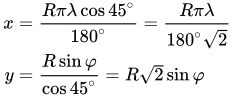
where λ is the longitude from the central meridian in degrees, φ is the latitude, and R is the radius of the globe used as the model of the earth for projection. For longitude given in radians, remove the π180°factors.
The various specializations of the cylindric equal-area projection differ only in the ratio of the vertical to horizontal axis. This ratio determines the standard parallel of the projection, which is the parallel at which there is no distortion and along which distances match the stated scale. There are always two standard parallels on the cylindric equal-area projection, each at the same distance north and south of the equator. The standard parallels of the Gall–Peters are 45° N and 45° S."
Source: Snyder, John P. (1989). An Album of Map Projections p. 19. Washington, D.C.: U.S. Geological Survey Professional Paper 1453. (Mathematical properties of the Gall–Peters and related projections.)
Got it?


No comments:
Post a Comment