Thursday, December 13, 2018

a few words about Mechanics and Plagiarism
The mechanics of a paper refers to formatting, grammar, usage, spelling, etc. I have written an essay to help you with this, cleverly titled The 500-Word Essay. I am not requiring your essay to be 500 words - it can be more than that, a lot more than that, or a little less than that. What is important is quality of writing, not quantity of words. Also note that I am not requiring parenthetical citations or a bibliography (Works Cited). Please click here to read my essay for details on mechanics.
Although this is not a massive term paper, it is still important to avoid plagiarism. It is expected that you do all of your own work on this paper. As part of the assignment, you may choose to refer to your notes, or to the handouts, or you may do some online research. But it should aways be clear what is your writing, and what information came from an outside source.
Here is an example of how to make it clear what is yours, and what is part of your research.
According to the Oxford English Dictionary, plagiarism is defined as "the action or practice of taking someone else's work, idea, etc., and passing it off as one's own." An honest student will make every effort to write their paper so the teacher can easily recognize what is the student's original work.
See what I did there? I used a direct quote, but I gave credit for it. It's that simple.
Although this is not a massive term paper, it is still important to avoid plagiarism. It is expected that you do all of your own work on this paper. As part of the assignment, you may choose to refer to your notes, or to the handouts, or you may do some online research. But it should aways be clear what is your writing, and what information came from an outside source.
Here is an example of how to make it clear what is yours, and what is part of your research.
According to the Oxford English Dictionary, plagiarism is defined as "the action or practice of taking someone else's work, idea, etc., and passing it off as one's own." An honest student will make every effort to write their paper so the teacher can easily recognize what is the student's original work.
See what I did there? I used a direct quote, but I gave credit for it. It's that simple.
Wednesday, December 12, 2018
classwork for Wed Dec 12
I will not be in class today, but you have plenty of work to do in my absence. The Honors section and Section 102 will meet today, and, as we discussed in class, you will spend your class time working on your exam essays. If you have already started your essay, you may work with a classmate and peer review each other's essay. If you haven't yet started writing, start today. This is a big part of your grade, and you need to devote time to your essay in order to do well.
I hope to see you soon. In the meantime, be productive and be nice to your sub.
Also: Olivia, Leigh, and Caitlin, please make up your test in class today. Your tests are sitting on my desk, so tell your sub where they are. Thank you.
I hope to see you soon. In the meantime, be productive and be nice to your sub.
Also: Olivia, Leigh, and Caitlin, please make up your test in class today. Your tests are sitting on my desk, so tell your sub where they are. Thank you.
Saturday, December 8, 2018
Essay Questions for Semester Exam
For the Human Geography Semester Exam, you will write essays from the following prompts. Sections 101 and 102 will write one essay; the Honors section will write two essays. The essays should be written in five-paragraph format:
Option C: Consider our studies of fertility (which include data on CBR and TFR) and mortality (CDR, Infant Mortality Rate, Life Expectancy, and Rate of Natural Increase). Describe the four (or five) stages of the Demographic Transition, beginning with the Industrial Revolution, proceeding to the present day, and projecting into the future. Be sure to discuss individual countries as you describe the different stages.
Students will have a chance to fine-tune their essays in class through a peer-review process. The Honors class will do this on Wed, Dec 12; sections 101 and 102 will do this on Thu, Dec 13. All three classes will review for the objective part of the semester exam on Fri, Dec 14.
The essay(s) will count for 25% of your exam grade; the objective portion will be 75%.
Also, as you requested, here is the link to the podcast we listened to in class on immigrants seeking asylum.- Paragraph 1: an introduction with a clear thesis (topic sentence). This paragraph should include three essential points, and set the structure for the rest of the essay
- Paragraph 2: start with your strongest point, and give evidence to support it
- Paragraph 3: make another essential point, again giving evidence to support it
- Paragraph 4: next, present your second strongest point, and give important facts to support it
- Paragraph 5: sum things up with a strong conclusion, where you summarize (don’t just repeat) the essence of your essay, tying it all together
Students will print their essays and turn them in at the beginning of class on Friday, December 14. Late papers will be docked one letter grade for each day they are late.
Here are your prompts:
Option A: Choose three nations from three different parts of the world. Discuss the challenges they face regarding population and migration, using information we learned during our studies (perhaps including CIA World Factbook data, population pyramids, Net Migration Rates, possible overpopulation or underpopulation). Also, analyze what each nation's leaders need to do to deal with these challenges.
Option B: Consider our studies of immigration, push and pull forces, quotas, asylum, legal and illegal immigrants, civil rights and human rights, and the current state of our nation. Then, thoughtfully answer these questions: What are the different ways in which United States immigration policy has evolved over the last 100 years? What are the positive and negative effects of these policies? What immigration policies would you recommend the US implement right now, and what would be the effects (both positive and negative) of your policies?
Option C: Consider our studies of fertility (which include data on CBR and TFR) and mortality (CDR, Infant Mortality Rate, Life Expectancy, and Rate of Natural Increase). Describe the four (or five) stages of the Demographic Transition, beginning with the Industrial Revolution, proceeding to the present day, and projecting into the future. Be sure to discuss individual countries as you describe the different stages.
Students will have a chance to fine-tune their essays in class through a peer-review process. The Honors class will do this on Wed, Dec 12; sections 101 and 102 will do this on Thu, Dec 13. All three classes will review for the objective part of the semester exam on Fri, Dec 14.
The essay(s) will count for 25% of your exam grade; the objective portion will be 75%.
In addition, here is a link to a video on sanctuary cities.
Also, I promised Section 102 I would post the last three slides of the "Why Do Migrants Face Challenges?" PowerPoint. So here they are!
•Immigration
Concerns in Europe
–Population growth in Europe is
fueled by immigration from other regions of the world, a trend disliked by many
Europeans.
•Biggest fear is that the host
country’s culture will be lost, because
immigrants:
–adhere to different religions
–speak different languages
–practice different food and other
cultural habits
•Hostility to immigrants has become
a central plank of some political parties in many European countries.
–Immigrants blamed for crime,
unemployment rates, and high welfare costs.
–
•Europeans
as Emigrants
–Inhospitable climate for immigrants
in Europe is especially ironic.
•Europe was the source of most of
the world’s emigrants, during the nineteenth
century.
•Most Europeans fear losing their
cultural heritage to that of new immigrants, while:
–Indo-European languages are now
spoken by half of the world, as a result of European emigrants.
–Christianity has the world’s largest number of adherents.
–European art, music, literature,
philosophy, and ethics have diffused throughout the world.
•Characteristics
of Migrants
–Ravenstein noted:
•Most long-distance migrants are
male.
•Most long-distance migrants are
adult individuals rather than families with children.
•Most long-distance migrants are
young adults seeking work rather than children or elderly people.
Tuesday, December 4, 2018
in-class work for Tuesday, December 4
I will not be in class today. Here is the work Section 101 and the Honors section will do in class.
- Read and take notes on pages 84-85 in the handout.
- This part is titled "Changing U. S. Immigration."
- Enter these notes in your blog.
Thank you for your cooperation with your substitute teacher. I hope to see you tomorrow.
Thursday, November 29, 2018
prepping for Friday's Honors class
Honors students: To be prepared for tomorrow's class discussion, please read the following three stories. You are encouraged to seek out other stories from other sources as well. If you plan to use other stories in the discussion, be ready to identify the source.
Migrants in Tijuana Run to U.S. Border, but Fall Back in Face of Tear Gas
Migrants at the Border: Here’s Why There’s No Clear End to Chaos
Saturday, November 17, 2018
some supplemental info
I have made an addition to the Helpful Links sidebar, found on the right hand side of this page.
I posted a link to the Hans Rosling: 200 Years in 4 Minutes video. Professor Rosling does a terrific job taking much of the material we have discussed in class, and making it relate to the world we live in.
I posted a link to the Hans Rosling: 200 Years in 4 Minutes video. Professor Rosling does a terrific job taking much of the material we have discussed in class, and making it relate to the world we live in.
Thursday, November 1, 2018
from the CIA Factbook to Population Pyramids
 |
| Harford County, 2000 (source: US Census Bureau) |
Also, I have included a TED-Ed video on Population Pyramids. It's more thorough and more complicated. Challenge yourself, and you might be surprised what you pick up.
Here's more: populationpyramid.net features a very cool interactive visualization of pyramids from every county (plus the entire world), and let's you pick any year from 1950 to 2100. Play around with this one and prepare to have your mind blown as you review the past and look into the future.
Finally, check out this pop/pyr for Harford County, based on figures from the 2000 US Census. Think about why it looks the way it does...
Saturday, October 27, 2018
CIA World Factbook assignment
The details for this assignment were posted on Veracross on Friday, but they are also included here for your convenience.
In this 10 point assignment, you will search the CIA World Factbook (found here) to find five pieces of information that reflect our studies in Population and Migration. For each of these facts you will write a brief paragraph describing why you found this fact interesting and how it relates to work we are doing in class. All work is to be posted to your blog, and the assignment is due before midnight Saturday night (Oct 27).
SPECIAL NOTE TO SECTION 102: Your deadline for this assignment is midnight Monday night (Oct 29). I will discuss this assignment in class with you in class on Monday. The other sections received this explanation in class on Friday. I am posting this assignment for you now, as a courtesy, in case you want to get started on it over the weekend.
The purpose of this exercise is for you to become familiar with the CIA World Factbook, and to make connections between what we are learning in class and the way things are in the real world.
Thursday, October 25, 2018
our studies of population continue...
 Sections 101 and 102 met today. The presentation covered some new ground, including what would make people feel the need to leave their homes and move to a new country (push forces), or what reasons would make someone want to go to a new country like the United States (pull forces). We also discussed some useful statistics like Rate of Natural Increase (RNI), Net Migration Rate (NMR), and Total Fertility Rate (TFR), which help us understand why a nation's population might rise or fall.
Wednesday, October 24, 2018
In studying Population and Migration, we will be taking the geographical and map reading skills we learned in the last few weeks, and applying them to real world situations, problems, and challenges.
Terms you will need to be familiar with include:

Terms you will need to be familiar with include:

- life expectancy
- birth rate
- death rate
- Rate of Natural Increase (RNI)
- infant mortality rate
- immigrant
- emigrant
- Net Migration Rate
- Total Fertility Rate (TFR)
- push forces
- pull forces
And, as always, there will be the Key Issues to consider:
- Where is the world's population distributed?
- Why is global population increasing?
- Why does population growth vary among regions?
- Why do some nations face health threats?
Monday, October 15, 2018
in-class assignment for Sections 101 and 102
Human Geography Class Assignment - Monday, October 15
I am unable to be in class today. Your in-class assignment
is to answer the following questions in your blog. This assignment is worth 10
points, and should be completed during the class period. Obviously, you can use
the Internet. Please work quietly and independently. No computer game-playing
allowed. If you don’t finish the assignment in class, it’s homework.
Ancient cartography. We
all know Eratosthenes made a map of the entire world. Name three other things
he is known for.
1.
2.
3.
Time zones. If it
is 10:00 am in Bel Air, what time is it in…
4.
Portland, Oregon
5.
Greenwich, England
6.
Toronto, Ontario
7.
The South Pole
Locations and place
names.
8.
List five toponyms that are named after physical
features.
9.
List five toponyms that are named after Native
American places.
10. List
five toponyms that are named after a person of prominence.
11. List
five toponyms that have some religious affiliation.
Latitude and
Longitude. Give the latitude and longitude for the following cities.
12. Baltimore,
Maryland
13. Quito,
Ecuador
14. Taveuni,
an island in Fiji
15. Christchurch,
New Zealand
16. Juneau,
Alaska
Antipodes. (Don’t
worry, this won’t be on the test. But it’s still cool.)
17. Give
the definition of Geographic Antipode.
Find the antipode for the following locations. I suggest www.antipodesmap.com.
18. Beijing,
China
19. Bermuda
20. Your
house
Saturday, October 13, 2018
context and the Key Issues
I keep bringing up the Key Issues, but it is important enough that it's worth repeating.
How do geographers describe where things are? The answer, of course, was found in the first part of this unit, when we looked at types of maps, latitude, longitude, scale, time zones, and GPS.
Why is each point on Earth unique? This can be answered through studying toponyms, places, locations, regions, and culture.
Why are different place similar? We cover this when we talk about globalization (of economy and culture) and diffusion.
Instead of just trying to memorize a bunch of definitions, I recommend thinking about these terms as ways to answer the key questions. It's called putting things into context.
Also... some of you have asked me to remind you of the cities/locations that you were supposed to put on the second set of maps I handed out. So here they are! (If you didn't finish putting them on your maps while we were in class, it would be a good idea to do that this weekend.)
How do geographers describe where things are? The answer, of course, was found in the first part of this unit, when we looked at types of maps, latitude, longitude, scale, time zones, and GPS.
Why is each point on Earth unique? This can be answered through studying toponyms, places, locations, regions, and culture.
Why are different place similar? We cover this when we talk about globalization (of economy and culture) and diffusion.
Instead of just trying to memorize a bunch of definitions, I recommend thinking about these terms as ways to answer the key questions. It's called putting things into context.
Also... some of you have asked me to remind you of the cities/locations that you were supposed to put on the second set of maps I handed out. So here they are! (If you didn't finish putting them on your maps while we were in class, it would be a good idea to do that this weekend.)
 |
| Abuja, Nigeria |
- The John Carroll School
- Chicago, Illinois
- San Francisco, California
- Greenwich, England
- Moscow, Russia
- Berlin, Germany
- Beijing, China
- Seoul, South Korea
- Honolulu, Hawaii
- Abuja, Nigeria
Thursday, October 11, 2018
a somewhat disjointed week
It's already Thursday, and I've only seen two classes all week. (sad face) Nevertheless, we will take a moment to review.
Monday: no school due to a holiday; Wednesday: no classes due to PSAT testing.
Tuesday and today: more discussion about regions and culture.
Just to make sure we are all on the same page, here is a brief look back at what we've covered so far this unit.
Monday: no school due to a holiday; Wednesday: no classes due to PSAT testing.
Tuesday and today: more discussion about regions and culture.
Just to make sure we are all on the same page, here is a brief look back at what we've covered so far this unit.
- ancient maps
- origins (Eratosthenes, Ptolemy, Chinese, Islamic, Age of Exploration)
- types (Mercator, Peters, Robinson)
- round globes vs. flat maps
- problems with projection
- purposes
- navigation (getting from Point A to Point B)
- reference tool (relative and absolute location)
- Geographic characteristics of places
- toponym, site, situation
- Map features
- scale
- latitude (parallels); longitude (meridians)
- equator, Prime Meridian, Tropics of Cancer and Capricorn
- degrees, minutes, seconds
- time zones (International Date Line, Greenwich Mean Time)
- GPS
- Global Positioning Systems
- how it works
- what it's good for
- possible disadvantages
- regions
- cultural landscape
- types of regions (formal, functional, vernacular)
Hope that proves helpful. See you in class!
Sunday, October 7, 2018
love these three-day weekends
After reading your blogs, it seems there is a difference of opinions regarding Friday's pop quiz. (I love differences of opinion!) Some of you hated it, saying there was not enough time to answer questions and too much pressure. Both good points. Keep in mind that it was only worth 10 points, and it will not have a monumental effect on your grade. Also, the next time you see these questions will be on a test, where the same questions will be worth more. So maybe the pop quiz was really a sneak preview.
 Also, I really enjoyed last week's discussion about how we are giving GPS, Alexa, Siri, ancestry.com, and maybe even law enforcement agencies permission to track us. Again, there was a difference of opinion, with some of you saying that being tracked is creepy, some saying you have no problem with being tracked, and some believing it just doesn't happen as much as we think.
To which I offer you this story that came out at the same time that we had our class discussions.
https://www.rollingstone.com/culture/culture-news/fitbit-apple-watch-crime-help-solve-733050/
On behalf of Siri and me, enjoy your weekend!

To which I offer you this story that came out at the same time that we had our class discussions.
https://www.rollingstone.com/culture/culture-news/fitbit-apple-watch-crime-help-solve-733050/
On behalf of Siri and me, enjoy your weekend!
Wednesday, October 3, 2018
Return of the Tests
Now all three sections have had their tests returned to them and reviewed in class. Like I said during the review, it is recommended that you hold on to these for use as study guides when the semester exams roll around in December. I also hope you got a better idea of how to approach test-essay writing, in my class and in other subjects.
 Seating has been rearranged in each of my three sections, to allow for an optimal learning experience for all students. I hope you enjoy the newly engineered classroom geography.
Speaking of (Human) Geography, be sure your notes include definitions of the following new terms:
 Seating has been rearranged in each of my three sections, to allow for an optimal learning experience for all students. I hope you enjoy the newly engineered classroom geography.
Speaking of (Human) Geography, be sure your notes include definitions of the following new terms:
- place
- location
- site
- situation
- toponym
- region
Also, check your notes for the Key Issues we identified at the beginning of this unit, and think about how these terms apply to these issues.
Monday, October 1, 2018
Alexa, tell me about GPS
Today's class discussion centered on the wonderful uses of Global Positioning Systems (such as getting very specific directions through our smartphones, or being able to find businesses by "telling" apps our location). But what about the potential downside to having technology track our location 24 hours a day? Do we compromise our privacy when we "allow" apps to know so much about us?
Welcome to one of the good news / bad news aspects of life in the twenty-first century!
Welcome to one of the good news / bad news aspects of life in the twenty-first century!
Friday, September 28, 2018
cleaning up the blogs
Yesterday and today we all played catch-up: students finished up their maps and blogs, and I was able to look more closely at the specifics of your blogs and offer some suggestions. Next week we will pick up where we left with mapping, including information on GPS, toponyms, sites, and regions.
In the meantime, have a good weekend, and I will see you next week!
In the meantime, have a good weekend, and I will see you next week!
Wednesday, September 26, 2018
do-it-yourself mapping
Today, the Honors section played catch-up to the other two sections, covering material on map scale, latitude and longitude, and time zones.
Section 101 raced ahead and began labeling maps with the following features:
Section 101 raced ahead and began labeling maps with the following features:
- the equator
- Prime Meridian
- the nation of your origin
- all seven continents
- all five oceans
- the International Date Line
- the Tropic of Capricorn
- the Tropic of Cancer
- the John Carroll School
Sunday, September 23, 2018
Monday's classwork
I will not be in class on Monday since I will be taking my Television Production students on a field trip to the Newseum in Washington, DC. Here is the work you will need to do in class today.
 I'm sure you can recall the presentation and class discussion we had on the Mercator map and the Peters Projection map. You also remember the video we watched on this topic, taken from The West Wing.
I want you to re-watch the video (found here) individually in class, using your earbuds, please. Keeping in mind what we have learned about these maps since watching it the first time, pay close attention to the points the "Organization of Cartographers for Social Equality" are making. Feel free to stop-and-start the video as you watch on your laptops so you don't miss anything.
In your blog, describe the points made by the cartographers. Are they valid points? You may wish to explain whether you agree or disagree with these points, and why.
This blog is worth 10 points, and, as always, it is due by midnight tonight.
I want you to re-watch the video (found here) individually in class, using your earbuds, please. Keeping in mind what we have learned about these maps since watching it the first time, pay close attention to the points the "Organization of Cartographers for Social Equality" are making. Feel free to stop-and-start the video as you watch on your laptops so you don't miss anything.
In your blog, describe the points made by the cartographers. Are they valid points? You may wish to explain whether you agree or disagree with these points, and why.
This blog is worth 10 points, and, as always, it is due by midnight tonight.
Thursday, September 20, 2018
no map is perfect (but the Peters is close)

I am simply amazed at the reactions from all of you! I have never seen students get so outraged by a Mercator map. And the unbridled joy you have shown the Peters Projection map has been inspiring.
Please... keep up the enthusiasm, and the energy, and the great work!
Wednesday, September 19, 2018
mapping out the next unit
As we begin the next unit, these are the key issues we will be considering:
Also, the Honors section asked a question about how the Peters map was constructed. I don't know how higher mathematics works, but if you do, then this explanation should make a lot of sense.
Got it?

- How do geographers describe where things are?
- Why is each point on Earth unique?
- Why are different places similar?
- Why are some human actions not sustainable?
Also, the Honors section asked a question about how the Peters map was constructed. I don't know how higher mathematics works, but if you do, then this explanation should make a lot of sense.
"The projection is conventionally defined as:
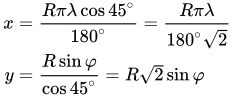
where λ is the longitude from the central meridian in degrees, φ is the latitude, and R is the radius of the globe used as the model of the earth for projection. For longitude given in radians, remove the π180°factors.
The various specializations of the cylindric equal-area projection differ only in the ratio of the vertical to horizontal axis. This ratio determines the standard parallel of the projection, which is the parallel at which there is no distortion and along which distances match the stated scale. There are always two standard parallels on the cylindric equal-area projection, each at the same distance north and south of the equator. The standard parallels of the Gall–Peters are 45° N and 45° S."
Source: Snyder, John P. (1989). An Album of Map Projections p. 19. Washington, D.C.: U.S. Geological Survey Professional Paper 1453. (Mathematical properties of the Gall–Peters and related projections.)
Got it?

Subscribe to:
Comments (Atom)